

The “You Will” Prophecies: How AT&T’s 1993 Ads Saw the Future
In 1993, the internet was a novelty mostly relegated to academic and military institutions. Dial-up connections hummed with erratic screeches, and cell phones, if you had one, resembled actual bricks. Yet, in the midst of this early technological landscape, AT&T launched an advertising campaign that was astonishingly prescient. Directed by David Fincher and featuring the reassuring voiceover of Tom Selleck, the “You Will” commercials asked viewers a series of hypothetical questions about the future.
Watching these ads today, in 2026, is less like looking back at a retro-futuristic fantasy and more like reviewing a checklist of modern daily life.
The premise of the campaign was simple: present a seemingly impossible technological feat, ask the viewer if they’ve ever done it, and then promise, “You will. And the company that will bring it to you? AT&T.” While AT&T wasn’t necessarily the sole provider of all these innovations, the overarching vision was remarkably accurate.
Let’s examine how the predictions from those 30-second spots align with our present reality.
The World in Your Hand: The Rise of the Smartphone and Tablet
One of the most striking visual motifs throughout the ads is people interacting with sleek, portable screens.
- “Have you ever sent a fax from the beach?” While faxes are mostly obsolete, the concept of sending complex documents from anywhere is a given. Today, we send PDFs, high-resolution photos, and videos from the beach—or anywhere else with a signal—using smartphones and tablets.
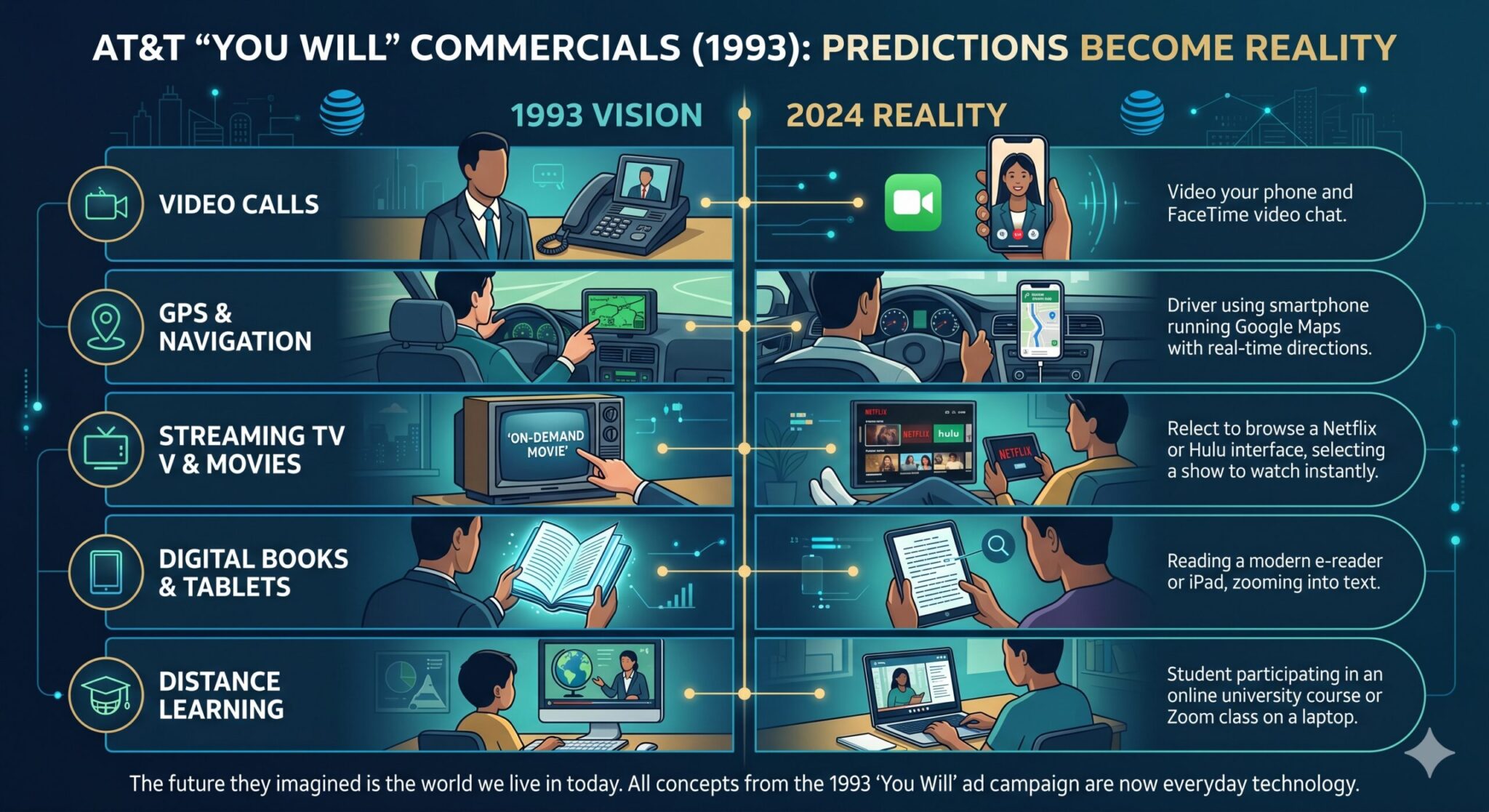
- “Have you ever read a book from a thousand miles away?” This is a direct prediction of e-readers and tablet computers like the Kindle and iPad. The ad showed a student accessing a digital library, a reality that transformed education and reading habits globally.
- “Have you ever received a phone call on your wrist?” The Apple Watch and its competitors have made this commonplace. The ad envisioned a clunky, futuristic bracelet, but the core functionality—a wearable communicator—is exactly what millions use daily.
Navigating the World: GPS and E-Commerce
The commercials also accurately foresaw how technology would fundamentally alter how we move and how we buy.
- “Have you ever crossed the country without stopping for directions?” The ad featured an early concept of an in-car navigation system displaying a map on a dashboard screen. Today, GPS is integrated into nearly every vehicle and smartphone, rendering physical maps largely obsolete for daily travel.
- “Have you ever paid a toll without slowing down?” Electronic toll collection systems like E-ZPass and FasTrak are now standard on highways worldwide, fulfilling this exact promise.
- “Have you ever bought concert tickets from a cash machine?” The ad envisioned specialized kiosks for purchasing event tickets. While those exist, the reality surpassed the prediction: we now buy tickets instantly through apps on our phones, bypassing the need for a physical “machine” entirely.
The Connected Home and the Rise of On-Demand
The “You Will” campaign didn’t just focus on mobility; it anticipated the connected, on-demand nature of our personal lives.
- “Have you ever tucked your baby in from a phone booth?” The “phone booth” part is anachronistic, but the underlying concept—video calling—is central to modern communication. FaceTime, Zoom, and WhatsApp video calls allow for intimate, visual connections across the globe.
- “Have you ever opened doors with the sound of your voice?” Voice-activated technology was a staple of sci-fi, and the ad embraced it. Today, smart home devices like Amazon Alexa and Google Assistant control locks, lights, and appliances with simple voice commands.
- “Have you ever watched the movie you wanted to, the minute you wanted to?” This was perhaps the most culturally significant prediction. The ad envisioned a video-on-demand service. This perfectly describes Netflix, Hulu, Disney+, and the entire streaming ecosystem that has largely replaced traditional video rental and broadcast television.
The Misses and the Magic
Were they perfectly accurate? No. The ads often featured physical styluses for touchscreens (which Steve Jobs famously dismissed, though they have seen a resurgence in specific contexts) and relied heavily on the concept of payphones equipped with screens. They couldn’t quite predict the total dominance of the ubiquitous smartphone that would consolidate so many of these functions into a single device. Furthermore, they didn’t foresee the social media landscape or the profound implications of data privacy that arose from this interconnectedness.
However, the “You Will” campaign remains a masterclass in technological forecasting. It didn’t get bogged down in the specific engineering of how these things would work; instead, it focused on what they would allow people to do. By centering on human desires—convenience, connection, and access to information—AT&T managed to sketch a remarkably accurate blueprint for the 21st century.
They asked us if we had experienced the future. Thirty years later, the answer is a resounding yes.